
📌 Why Property Matters
Property is valuable because it serves a practical purpose and is relatively scarce. As an investment, it stands apart from other asset classes due to:
- 🏠 Uniqueness: No two properties are exactly alike.
- 🧩 Specialization: Buildings are often designed for specific uses, making repurposing difficult.
- 💧 Illiquidity: Property cannot easily be converted into cash, unlike shares or money market investments.
🛠️ Ways to Invest in Property
There are two main categories:
1. Direct Property Investments
These include:
- Full title and sectional title properties
- Timeshare and share block schemes
- Retirement villages
- Property syndications and leasebacks
- Participation mortgage bonds
I’ll cover these in a separate post.
2. Listed Property Investments
Traded on the Johannesburg Stock Exchange (JSE), these include:
- Real Estate Investment Trusts (REITs)
- Listed property companies
- Property index funds and the FTSE/JSE Property Indexes
Let’s focus on listed property vehicles in this post.
🏢 Listed Property Vehicles
Unlike direct property, listed property investments offer varying degrees of liquidity. Shares in listed property vehicles can be bought and sold more easily, though liquidity still depends on market conditions.
📘 Real Estate Investment Trusts (REITs)
Before REITs were introduced in South Africa (on 1 April 2013), listed property was structured as:
- Property Loan Stock Companies (PLS)
- Property Unit Trusts (PUT)
REITs are now the global standard, used in over 25 countries. They allow investors to earn income from immovable property—such as shopping centers, office blocks, warehouses, hotels, and hospitals—without owning the property directly.
🎯 REIT Objectives
- Provide steady rental income
- Offer capital growth from underlying properties
🧾 SARS Requirements for REIT Status
To qualify, an entity must:
- Hold property worth over R300 million
- Earn at least 75% of income from rentals
- Distribute at least 75% of profits annually
- Keep debt below 60% of total assets
These rules must be embedded in the trust deed (for PUTs) or memorandum of incorporation (for PLSs). Trustees or directors are responsible for compliance.
💰 Tax Treatment
- REITs are exempt from capital gains tax.
- Investors pay normal income tax on distributions received.
🧱 Types of REITs
🏛️ Company REITs (formerly PLSs)
- Shareholders vote on REIT status and enjoy full protection under the Companies Act.
- Directors ensure compliance with JSE rules.
- Management may be internal or external.
📜 Trust REITs (formerly PUTs)
- Must meet JSE listing requirements (excluding Takeover Regulations).
- Registered with the Registrar of Collective Investments Schemes.
- Trustees safeguard investor interests and ensure compliance with the Collective Investment Schemes Control Act.
- Must appoint external asset and property managers.
Learn more at SA REIT Association website.
https://sareit.co.za/
🏗️ Listed Property Companies
These companies follow two models:
- Long-term rental income from owned/developed properties
- Buying and developing properties for resale at a profit
They are not bound by REIT regulations, giving them more flexibility in borrowing and profit distribution.
- Subject to normal company tax
- Investors receive dividends. Dividents are taxed at 20% (Withholding tax)
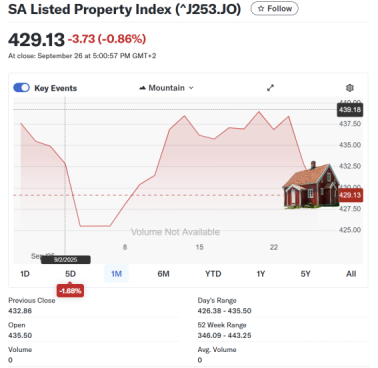
📊 FTSE/JSE Property Indexes
Investors can track the performance of listed property via indexes. These reflect the market value and trends of property-related shares.
Explore more on the JSE Property Index Brochure.
https://www.jse.co.za/media/document/indices/ftsejse-property-indices-brochure
📈 Property Index Funds
Index funds offer a low-cost way to invest in listed property by tracking the property index. They provide diversification without the need to pick individual shares.
Examples include:
- Satrix Property Index Fund
https://satrix.co.za/fund/mdd/SAPIF - 1nvest SA Property ETF
https://1nvest.co.za/products/index-tracking-unit-trusts/1nvest-sa-property-etf/ - Sygnia Listed Property Index Fund
https://www.sygnia.co.za/fund/sygnia-listed-property-index-fund/
💸 Investment Returns and Risks
Property returns are complex due to:
- Illiquidity
- Unique characteristics of each property
For commercial and industrial property, the Investment Property Data Bank tracks institutional trends.
🧮 Tax Considerations
- Dividends: Taxed at 20%
- Capital Gains: Max effective rate of 18%
- Interest: Taxed at normal rates, with exemptions:
- R23,800 (under 65)
- R34,500 (65 and older)
Much of the return from listed property is interest-based, which is taxable.
📉 Market Sensitivity
Listed property values are influenced by:
- Interest rate movements
- Economic conditions
- Infrastructure quality
- Legislative risks (e.g., expropriation without compensation)
While listed property once outperformed the FTSE/JSE All Share Index, recent returns have been volatile—especially post-COVID. Past performance is not a guarantee of future results.
🇿🇦 Final Thoughts: Property Investment in the South African Context
While listed property offers diversification and liquidity, it’s essential to ground investment decisions in the realities of South Africa’s current environment.
Across most metropolitan areas, property values have come under pressure due to:
- 🏚️ Deteriorating infrastructure: Aging water systems, unreliable electricity supply, and neglected roads reduce the appeal and functionality of properties.
- 🧾 Poor service delivery: Municipal inefficiencies and governance challenges erode investor confidence and tenant satisfaction.
- ⚖️ Policy uncertainty: The ongoing debate around the Land Expropriation Bill—especially the possibility of expropriation without compensation—has created anxiety among property owners and investors. While the bill aims to address historical injustices, its implementation and legal clarity remain contentious.
The City of Cape Town has bucked the national trend, maintaining relatively strong property values. This divergence highlights how local governance can significantly influence property market dynamics—even within the same country.
🧭 Navigating Forward
Investors should approach property with a long-term mindset, balancing potential returns with risks tied to location, legislation, and macroeconomic trends. Listed property vehicles like REITs offer a way to diversify exposure and mitigate some of the risks associated with direct ownership.
As always, past performance is not a guarantee of future returns. But informed, context-aware decisions can help investors align their portfolios with both opportunity and resilience.
📊 Listed Property Challenge: “Build Your Portfolio”
You’ve been given a virtual budget of R100,000 to invest in listed property. Your goal is to build a diversified mini-portfolio using only listed property vehicles available on the JSE.
🧩 Your Task:
- Choose at least two of the following investment types:
- A REIT (e.g., Growthpoint, Equites, or any REIT listed on the JSE)
- A listed property company (not classified as a REIT)
- A property index fund (e.g., Satrix Property ETF, Sygnia Listed Property Index Fund)
- Allocate your R100,000 across your chosen investments. You can split it however you like.
- Justify your choices:
- Why did you choose those specific investments?
- What risks are you trying to manage?
- What kind of income or growth do you expect?
- Bonus: Identify one economic or policy factor (e.g., interest rates, infrastructure trends, legislation) that could affect your portfolio’s performance. Explain how your portfolio is positioned to respond to it.